On this page
DSEAR is the Dangerous Substances and Explosive Atmospheres Regulations 2002, the law that controls fire and explosion risk from flammable substances such as petrol. On a petrol forecourt it means the site must be assessed and divided into hazardous zones (Zone 0, 1 and 2) where flammable vapour could be present. Contractors must know where those zones are, keep ignition sources out of them unless the work is controlled by a permit, and use equipment suitable for the zone. The site's hazardous area drawing is the authority for where the zones are.
What does DSEAR stand for?
DSEAR stands for the Dangerous Substances and Explosive Atmospheres Regulations 2002. They apply wherever substances that can cause a fire or explosion are used or stored at work, and petrol is one of the most common examples.
Under DSEAR, the employer or site operator must:
- Assess the fire and explosion risks from dangerous substances
- Eliminate those risks or reduce them as far as reasonably practicable
- Classify places where explosive atmospheres may occur into zones
- Make sure equipment used in those zones is suitable
- Mark entry points to zoned areas where necessary
- Provide information and training to people who could be affected, including contractors
- Have arrangements for accidents and emergencies
For a contractor, the practical effect is simple: the site will have identified where flammable vapour can be present, and you must work within the controls set for those areas.
Why petrol is so hazardous
Petrol is far more dangerous than most people realise, for three reasons.
It gives off flammable vapour at very low temperatures. Petrol's flash point is around minus 40°C, so in any UK weather it produces vapour that can ignite.
The vapour is heavier than air. It does not rise and disperse. It flows downhill and collects in low points: drains, interceptors, manhole chambers, tank pits, cable ducts and trenches. Vapour can travel some distance from where it was released.
It takes very little to ignite. A spark from a tool, static discharge, a hot surface, a phone or a cigarette can ignite a flammable mixture.
Diesel is much less volatile at normal temperatures, but it is still a dangerous substance and is often stored alongside petrol, so sites treat the fuel system as a whole.
Zone 0, Zone 1 and Zone 2 explained
DSEAR uses zones to describe how likely an explosive atmosphere is in a given place. For gases and vapours such as petrol, there are three.
| Zone | Explosive atmosphere is... | Typical forecourt examples |
|---|---|---|
| Zone 0 | Present continuously, for long periods or frequently | Inside fuel storage tanks, above the liquid |
| Zone 1 | Likely to occur occasionally in normal operation | Inside dispenser housings, around tank fill points and vent outlets, inside manhole chambers and tank pits |
| Zone 2 | Not likely in normal operation, and short-lived if it occurs | Areas around dispensers, the tanker delivery area during a delivery, around vent pipes and drainage, beyond the Zone 1 boundaries |
Dusts have their own equivalent zones (20, 21 and 22), but these are not usually relevant on a forecourt.
The examples above are typical, not universal. Zone extents depend on the site's layout, equipment and vapour recovery systems. Every forecourt should have a hazardous area classification drawing showing the zones for that site. Ask to see it before work starts.
Where the zones are on a typical forecourt
Most forecourts follow a similar pattern, set out in industry guidance known as the "Blue Book" (Design, construction, modification, maintenance and decommissioning of filling stations), published by APEA and the Energy Institute.
- Underground storage tanks. The space inside the tank above the fuel is Zone 0. Tank access chambers and pits are usually Zone 1.
- Fill points and the tanker stand. Areas around fill points are zoned, and the tanker delivery area becomes a hazardous area while a delivery is taking place.
- Vent pipes. The outlets of tank vent pipes, often at height on a stack or building wall, have a zone around them where vapour is released during deliveries.
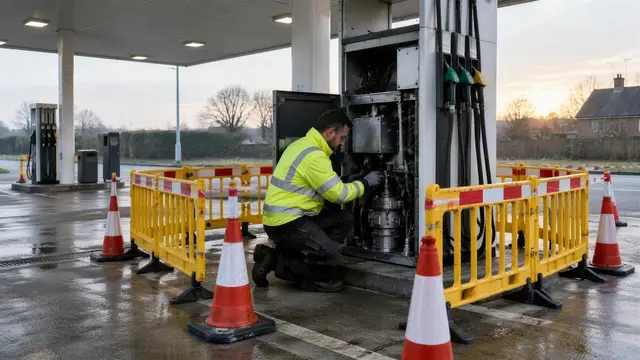
- Dispensers. The inside of a dispenser housing is typically Zone 1, with a Zone 2 area around the outside of the dispenser at ground level.
- Drainage and interceptors. Forecourt drains run to an oil and petrol interceptor. Because vapour collects there, interceptors and drainage chambers are treated as hazardous areas.
- Vapour recovery equipment. Stage 1b and Stage 2 vapour recovery systems reduce emissions but have their own zones.
Ignition sources contractors bring onto site
Most forecourt fires and near misses involve an ignition source that should not have been in a zoned area. Common ones include:
- Power tools, grinders, drills and cutting equipment
- Non-rated electrical equipment, extension leads and work lights
- Mobile phones, radios and other battery devices
- Vehicles and generators parked or running in zoned areas
- Hot work: welding, cutting, brazing and soldering
- Static from clothing, plastic sheeting or fuel flowing through hoses
- Smoking and vaping
In zoned areas, only equipment designed and certified for that zone may be used. Equipment for explosive atmospheres is marked with the Ex symbol and certified under ATEX or the UK equivalent. Anything else, including ordinary hand-held electrical equipment, needs the area to be made safe first under a permit.
What contractors must do before work starts
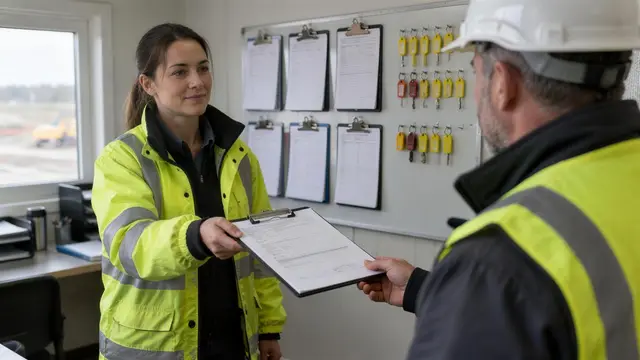
- Get the site briefing. Ask where the hazardous zones are and look at the hazardous area drawing.
- Check whether your work needs a permit. Work in or near a zone that could introduce an ignition source, or that involves opening up the fuel system, will normally be controlled by a permit to work. See permits to work on forecourts.
- Check your equipment. Make sure anything going into a zone is suitable for that zone.
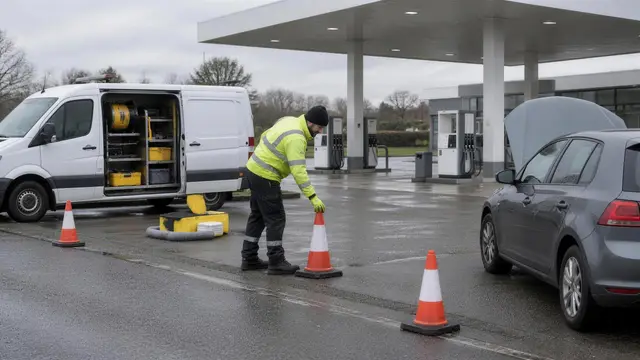
- Plan barriers and exclusion areas. Forecourts stay open to the public, so your work area must be fenced off from customers and vehicles.
- Know the emergency arrangements. Where the emergency stop switches are, where the fire extinguishers are and how to raise the alarm.
- Stop if conditions change. A delivery arriving, a spill or a smell of fuel can change the risk in an instant.
What a forecourt DSEAR risk assessment should cover
Contractors do not write the site's DSEAR assessment, but knowing what it should contain helps you ask the right questions. A forecourt assessment will normally cover:
- The dangerous substances on site: petrol, diesel, any other fuels, and products such as LPG or AdBlue where present
- The activities that could release them: dispensing, deliveries, tank gauging, maintenance and cleaning
- The hazardous area classification: the zones and their extent, shown on a drawing
- Ignition sources and how they are controlled: equipment selection, earthing and bonding, site rules for phones, smoking and vehicles
- Measures to reduce the risk: vapour recovery, overfill prevention, leak detection, drainage to an interceptor
- Emergency arrangements: emergency stop switches, spill response, fire-fighting equipment and evacuation
- Information for contractors: how zones and rules are communicated, and when permits are required
If you are asked to work in or near a zone and nobody can show you where the zones are, stop and ask before you start.
Spills, leaks and emergencies
Most forecourt incidents start with fuel where it should not be. Know what to do before you need to:
- Stop work and make your equipment safe. Do not switch electrical equipment on or off in the vapour if that could create a spark; follow the site's procedure.
- Raise the alarm with the site staff, who will use the emergency stop switches to cut power to the dispensers if needed.
- Keep people away, including customers and their vehicles.
- Contain small spills with the site's spill kit if it is safe and you are trained to do so. Keep fuel out of drains that do not run to the interceptor.
- Call the emergency services for anything beyond a minor spill, any fire or any strong smell of fuel that does not clear.
Report every spill and near miss. They are the early warning that a control is not working.
Who enforces fuel safety on forecourts?
Forecourts that dispense petrol must hold a petroleum storage certificate under the Petroleum (Consolidation) Regulations 2014, issued by the local Petroleum Enforcement Authority, usually the local authority's trading standards or fire service. DSEAR itself is enforced by HSE or the local authority depending on the premises. Site operators set their own contractor rules on top of the legal minimum, which is why most require the SPA Petrol Retail passport.
How DSEAR is covered in the SPA Petrol Retail passport
The Petrol Retail sector day covers DSEAR directly: fuel hazards and properties, restricted and hazardous areas, zone classification, delivery hazards, vapour recovery and contractor hazards, followed by the controls that make work safe. It is designed to make sure every contractor on a forecourt understands the zones before they arrive. About the Petrol Retail passport.
Frequently asked questions
What does DSEAR mean?
DSEAR means the Dangerous Substances and Explosive Atmospheres Regulations 2002, which control the risk of fire and explosion from flammable substances at work.
What is a Zone 1 area on a petrol station?
A place where an explosive atmosphere is likely to occur occasionally in normal operation. Inside dispenser housings, tank chambers and areas around fill points and vents are typical examples, but the site's hazardous area drawing is the authority.
Can I use my mobile phone on a forecourt?
Not in hazardous zones unless the site rules allow it and the device is suitable. Treat phones and battery devices as potential ignition sources and follow the site's rules.
Who is responsible for DSEAR on a forecourt?
The site operator must carry out the DSEAR risk assessment and classify the zones. Contractors must follow the controls, and their employers must make sure the work is planned and carried out safely.
Do I need DSEAR training to work on a forecourt?
Forecourt operators typically require the SPA Petrol Retail passport, which includes DSEAR awareness. Specialist roles, such as those designing or inspecting hazardous area equipment, need further competence.