On this page
Yes, in most cases. Forecourt operators in the UK expect contractors working on, in or around a petrol filling station to hold the SPA Petrol Retail passport. Under the scheme, each contractor must hold their own passport to be eligible to work. It is a two-day course (the SPA Core Day plus a Petrol Retail day), valid for three years and renewed with a one-day refresher. It is the most widely held SPA passport, with more than 20,000 forecourt contractors trained since the first courses in October 2000.
Who needs the Petrol Retail passport?
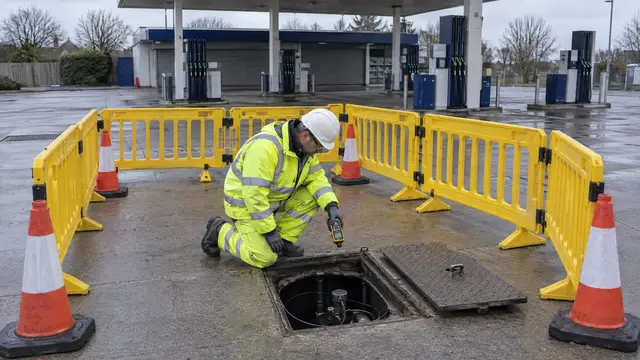
The passport is designed for anyone whose work brings them onto a live forecourt or into contact with fuel, rather than the forecourt's own shop staff. That includes:
- Forecourt equipment engineers servicing pumps, dispensers, tank gauging and payment systems
- Electricians, builders, groundworkers and civil engineering contractors
- Tank, pipework and interceptor maintenance and cleaning contractors
- Canopy, signage, car wash and shop refit contractors
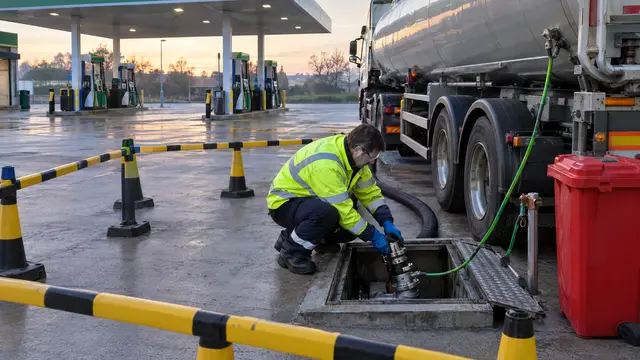
- Contractors who transport fuel or come into contact with dangerous oils, or who work in vehicle mis-fuelling
If your job involves working on a petrol station site while it is trading, or working on the fuel system itself, expect to be asked for the passport. Ask the site operator or main contractor if you are unsure.
Why forecourts need a specific passport
A petrol forecourt is an unusual workplace. It is open to the public, vehicles are moving constantly, deliveries of highly flammable fuel arrive by road tanker, and large parts of the site are classified as hazardous areas where an ignition source could set off a fire or explosion.
General health and safety training does not cover this. Petrol gives off flammable vapour at temperatures well below freezing, the vapour is heavier than air and collects in drains, pits and chambers, and everyday tools and phones can become ignition sources in the wrong zone. A contractor who does not understand those risks can endanger themselves, the public and the whole site.
The SPA Petrol Retail course was developed with the industry to cover exactly these hazards. The sector content is maintained with Fuels Industry UK (formerly UKPIA) and Cogent Skills.
What the course covers
Day one: the SPA Core Day. Six modules on health, safety and environmental basics: organising for safety, the workplace, tools, plant and machinery, health, procedures and the environment. Each has a short assessment paper and the pass mark is 80 per cent.
Day two: Petrol Retail. Two modules built around the forecourt.
Hazards on a petrol filling station: types of hazard, fuel hazards and fuel properties, DSEAR, restricted areas on a forecourt, hazardous areas and zone classification, delivery hazards, vapour recovery, customer hazards and contractor hazards.
Controlling work on a forecourt: communication, documentation, safety method statements, clearance certificates, permits to work and task classification.
Two of these topics have their own guides: DSEAR and hazardous zones on forecourts and permits to work on forecourts.
How to get the Petrol Retail passport
- Find a course. Petrol Retail is the most frequently scheduled SPA course, with dates in most regions and live online. Use the course finder to see upcoming dates from every accredited provider.
- Check for exemptions. If you hold a recognised health and safety qualification covering at least 80 per cent of the Core Day, you may be able to skip day one. See exemptions.
- Attend and pass. You can take the course in a classroom or live online with a trainer.
- Receive your passport. SPA issues the card within ten working days of receiving your provider's paperwork. It shows your photograph, passport ID, the Petrol Retail sector and its expiry date.
Renewing your Petrol Retail passport
The passport lasts three years. Renew with the one-day Petrol Retail refresher in the six months before your expiry date. Renew inside that window and you keep your original anniversary date.
There is no grace period. Since 2 April 2012 for Petrol Retail, the expiry date has been the definitive end of the passport, and the wider three-month allowance ended for all SPA courses on 31 July 2020. If your passport expires, you sit the full two-day course again. How renewals work.
What site operators check at the gate
Expect the site or the main contractor to check:
- That the photograph matches you
- That the card shows the Petrol Retail sector
- That the Petrol Retail expiry date has not passed
On top of the passport, the site will give you a site-specific briefing, and higher-risk work will be controlled through permits and method statements. The passport is the baseline, not the whole system.
Is the passport needed for tanker drivers?
Road tanker drivers delivering fuel are covered by a separate scheme, the Petroleum Driver Passport (PDP), which trains drivers in loading, transporting and offloading fuel. A contractor working on the forecourt itself needs the SPA Petrol Retail passport. Our comparison of the SPA Petrol Retail passport and the PDP explains the difference.
Common reasons contractors are turned away from forecourts
Most refusals at the forecourt are avoidable:
- Expired passport. The most common reason. There is no grace period, so a passport that expired yesterday is treated the same as none at all.
- Wrong passport. A general construction card or a CCNSG passport does not replace the Petrol Retail passport on sites that require it.
- No passport for every person. Each contractor must hold their own passport. A supervisor's card does not cover the team.
- Missing paperwork. No risk assessment, method statement or permit for work that needs one.
- Unsuitable equipment. Tools or electrical equipment that cannot be used in hazardous zones.
A quick check of passports, dates and paperwork before the van leaves the yard saves a wasted trip.
For forecourt operators
If you run forecourts, asking for the passport is the simplest way to make sure every contractor understands fuel hazards before they arrive. Write the requirement into your contractor conditions, check cards on arrival and keep a record. Our employer guide explains how to introduce and enforce a passport requirement.
Frequently asked questions
Do petrol station shop staff need the SPA Petrol Retail passport?
The passport is aimed at contractors working on, in or around the forecourt and its fuel systems. Forecourt retail staff are trained by their employer for their own roles. SPA also offers forecourt e-learning for employees, separate from the contractor passport.
How long does the Petrol Retail passport last?
Three years. You renew it with a one-day course in the six months before expiry.
Can I take the Petrol Retail course online?
Yes. Petrol Retail is eligible for live online delivery with a trainer as well as classroom delivery.
Does the passport cover E10 petrol?
The course covers fuel properties and forecourt hazards generally. The Energy Institute publishes an E10 checklist for forecourt work; ask your provider how it applies to the work you do.
What if I already have a CCNSG passport?
CCNSG is the standard for engineering construction, not forecourts. Forecourt operators in the SPA scheme ask for the SPA Petrol Retail passport.