On this page
They do different jobs. EMSS, the Essential Minimum Safety Standard, is an umbrella safety passport card used mainly in high-hazard industries such as oil and gas, power, renewables, chemicals and water treatment. You can get it through its own online course, or by applying with a passport you already hold, and SPA is on the list it accepts. An SPA passport is a trainer-led course written with each industry, and it is the standard on petrol forecourts, in food and drink manufacturing and in quarries. If a site asks for EMSS and you hold SPA, you can apply for an EMSS card using your SPA passport rather than training again.
What EMSS is
EMSS stands for Essential Minimum Safety Standard. It describes itself as an industry-derived organisation set up to create a safety passport fit for high-hazard work, and it has operated as a not-for-profit scheme. Its card shows that the holder has a verified level of underpinning health, safety and environmental knowledge, ready for each site's own induction.
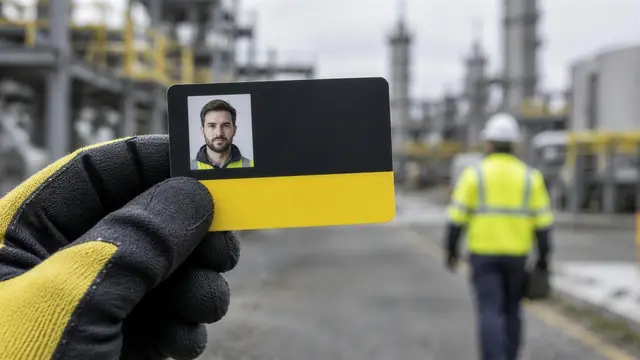
The EMSS card carries a unique passport number, the holder's photograph and a QR code. Scanning the code, or looking up the number, opens an online profile where the holder or their employer can add other qualifications. Cards are valid for up to three years.
There are two ways to get one:
- The National Safety Passport course, an online health and safety awareness programme of 22 modules that takes about three to four hours and can be completed in more than one sitting
- Applying with an accepted qualification you already hold. EMSS lists several, including SPA, VCA, IOSH Managing Safely, the NEBOSH General Certificate and CITB site management and supervisor courses. Each has its own verification time and fee, shown on the EMSS application page
What an SPA passport is
An SPA passport is a trainer-led course, delivered by an accredited provider in a classroom or live online. Most SPA passports pair a common Core Day with a sector day written with that industry. The forecourt sector day, for example, was developed with Fuels Industry UK and Cogent Skills and covers fuel properties, DSEAR zones, delivery hazards and permits on a live petrol station.
Each module has an assessment, and the card lists every sector you hold with its own expiry date. Most SPA passports last three years and are renewed with a one-day refresher in the six months before expiry.
Side by side
| SPA passport | EMSS card | |
|---|---|---|
| What it is | An industry safety passport course and card | An umbrella safety passport card, with its own online course as one route in |
| Where it is used | Petrol forecourts, food and drink manufacturing, quarries and mineral products, plus other SPA sectors | High-hazard industries such as oil and gas, power generation, renewables, chemicals and water treatment |
| How the training is delivered | Trainer-led, in a classroom or live online, with a sector day written by industry | Self-paced online course of about three to four hours, or an existing accepted qualification |
| Validity | Three years for most passports (five for Core Construction) | Up to three years |
| Checking a card | Passport ID and surname, through SPA | QR code or passport number, linked to an online profile |
| Does one count towards the other? | EMSS does not count towards an SPA passport | SPA is one of the passports EMSS accepts for an EMSS card |
Which one do you need?
As with every passport scheme, the answer is whichever card the site asks for.
- Working on petrol forecourts, fuel storage or tanker delivery areas: the SPA Petrol Retail passport. Its content is specific to forecourts and is not covered by a general awareness course.
- Working in food or drink factories: the SPA Food and Drink passport.
- Working in quarries, asphalt or concrete plants: the MPQC/SPA Quarry Safety Passport.
- A site or client in another high-hazard industry names EMSS: an EMSS card. If you already hold SPA, check the EMSS application page for the route that accepts it.
If you already hold SPA
If you hold an in-date SPA passport and a client asks for EMSS, you do not necessarily need to take another course. EMSS lists SPA among the qualifications it accepts, so you can apply with your SPA details and supporting evidence and pay EMSS's verification fee. Keep your SPA passport in date, because the EMSS card relies on the qualification behind it.
Your SPA passport stays your proof of training for SPA sectors. An EMSS card does not replace it on a forecourt, in a food factory or in a quarry.
A note on names
EMSS is often searched for as the "EMS safety passport" or "EMS card". They mean the same scheme: the Essential Minimum Safety Standard.
"National safety passport" is used loosely online. EMSS's own course is called The National Safety Passport. CCNSG's card is the CCNSG Safety Passport. SPA has run national safety passport schemes since 1999. These are different schemes from different organisations, so when a site asks for a "safety passport", ask which scheme they mean. Our guide to which health and safety card you need sets out the main ones.
For employers
If you set contractor entry rules, name the scheme or schemes you accept and say why. A general awareness card can be a reasonable baseline for some work. For work with specific hazards, such as forecourts, food production and quarries, an industry-written passport covers what a general course does not. HSE encourages organisations to accept more than one passport scheme where they are confident the training covers what the work needs. Our employer guide explains how to set and check a passport requirement.
Frequently asked questions
What does EMSS stand for?
Essential Minimum Safety Standard. It is an umbrella safety passport card used mainly in high-hazard industries such as oil and gas, power, renewables, chemicals and water treatment.
Is the EMS safety passport the same as EMSS?
Yes. People often search for the EMS safety passport or EMS card, but the scheme is called EMSS, the Essential Minimum Safety Standard.
Can I get an EMSS card with my SPA passport?
EMSS lists SPA among the qualifications it accepts, so an SPA holder can apply for an EMSS card with their SPA details rather than taking EMSS's own course. EMSS charges a verification fee.
Does an EMSS card count as an SPA passport?
No. Forecourts, food and drink sites and quarries in the SPA scheme ask for the relevant SPA passport, which includes an industry-written sector day.
How long is an EMSS card valid?
EMSS cards are valid for up to three years.
Is the EMSS course online?
Yes. EMSS's own route, The National Safety Passport, is a self-paced online course of about three to four hours.